Tous les articles par alex
Perte de poids
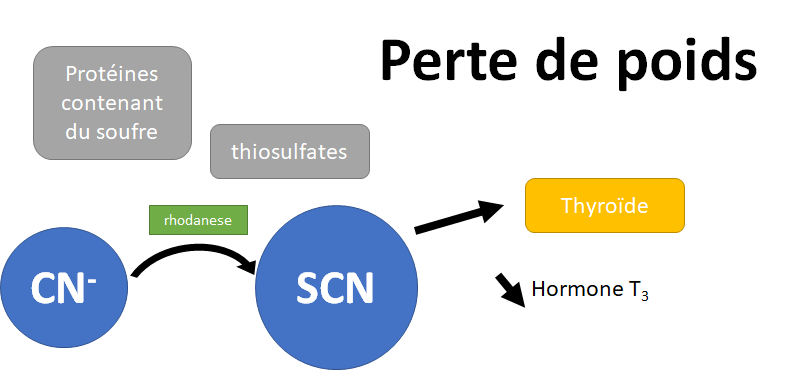
Les thiocyanates ont une action sur la thyroïde, également impliquée dans la régulation du poids.
–
Chez les enfants exposés au cyanure au Congo, à travers une alimentation riche en manioc, on note clairement un retard de croissance expliqué notamment par le manque de disponibilité du soufre, utilisé pour détoxifier le cyanure (Source : https://www.ncbi.nlm.nih.gov/pubmed/10824211 ).
Ce mécanisme important dans la croissance pourrait également indiquer un métabolisme ralenti chez des personnes ayant terminé leur croissance mais ayant subi une intoxication au cyanure, d’autant plus que cela a été montré en modèle animal comme chez le rat où la disponibilité en soufre était déterminante dans la perte de poids (Source : https://www.ncbi.nlm.nih.gov/pubmed/490674 ), le chien (Source : https://www.ncbi.nlm.nih.gov/pubmed/1445827 ), et même chez l’homme où la moitié des employés intoxiqués ont perdu du poids de façon importante (Source : https://www.ncbi.nlm.nih.gov/pubmed/3965790 ).
Dans un second temps, la thyroïde peut être affectée par le biais de la production de thiocyanates, et diminue la quantité de triiodothyronine responsable de la croissance et du métabolisme en général (Source : https://www.ncbi.nlm.nih.gov/m/pubmed/11469509/ ).
OEIL ET GAZ TOXIQUES
De la clinique de la vision
Les gaz lacrymogenes sont des toxiques de la surface oculaire
Substance chimique irritante
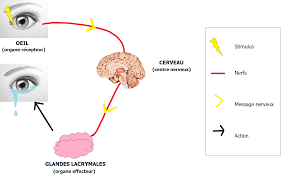
Utilisés en spray ou en grenade, ces gaz contiennent des substances chimiques irritantes à la fois pour les yeux, les glandes lacrymales, les voies respiratoires et la peau. Ils n’ont pas vocation à être dangereux. Cependant, dans certaines situations particulières (espace confiné, volume de gaz reçu important, personne allergique ou malade, etc.), ils peuvent entraîner la nécrose de certains tissus, des œdèmes, voire exceptionnellement le décès. A la sortie du spray; La lacrymation provoquée est notée dans de nombreuses conditions En réalité, le gaz lacrymogène n’est pas un gaz. Les composants chimiques qui produisent l’épanchement lacrymal sont des agents irritants que l’on peut conditionner aussi bien sous forme de vapeur que de gel ou de liquide. Les bombes lacrymogènes disponibles sont de différentes tailles. Les 2 principes actifs utilisés sont le C.S et l’O.C (poivre) dit bombe au poivre ou spray au poivre.
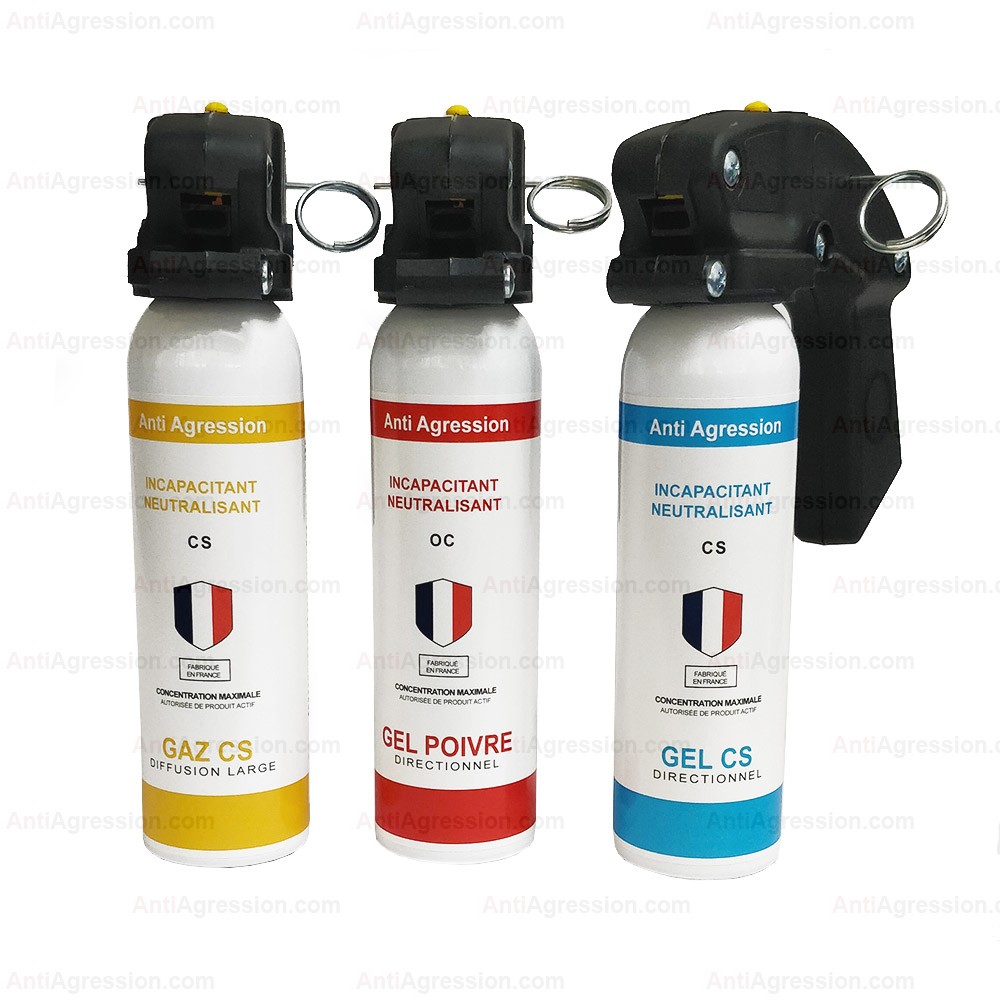
L’aérosol lacrymogène ou bombe anti-agression est l’une des meilleures armes d’auto-défense étant donné de son efficacité rapide et surtout le maintien d’une certaine distance de sécurité par rapport à l’éventuel agresseur.Les emplois sont aussi bien la défense individuelle contre une agression inopinée que dans le cadre d’une action de groupe comme par exemple une dispersion de foule.
La gazeuse lacrymogène ou spray de défense est une arme de défense légale, libre à la vente mais interdite de port et transport.
le gaz est très condensé et parfois encore sous forme dense. Il est d’autant plus dangereux que distribué de très près. De plus, des doutes existent sur leurs effets à long terme (pneumopathie chronique, malformations des bébés dont la mère a reçu de tels gaz pendant sa grossesse, etc.).
Si le but est de faire pleurer la conséquence c’est de rendre la situation insupportable et donc d’obliger l’assaillant à reculer, à se protéger et de fuir: c’est une mise hors situation d’attaque. C’est pourquoi le larmoiement est accompagné de douleurs, gènes, sensation de brûlure…
Que faire sur le moment ?
Il faut bien sûr s’éloigner au maximum de la source du gaz lacrymogène pour limiter l’exposition. Et que les yeux brûlent ou non, il ne faut surtout pas les frotter avec les mains car il est probable que du gaz se soit déposé sur la peau des mains, Une fois les mains savonnées et rincées, il faut rincer abondamment les yeux avec du sérum physiologique ou un produit de lavage oculaire ou en l’absence de l’un de ces produits, avec de l’eau tiède. Ce qui compte c’est la précocité du lavage, son abondance et l’éloignement de la source des gaz.
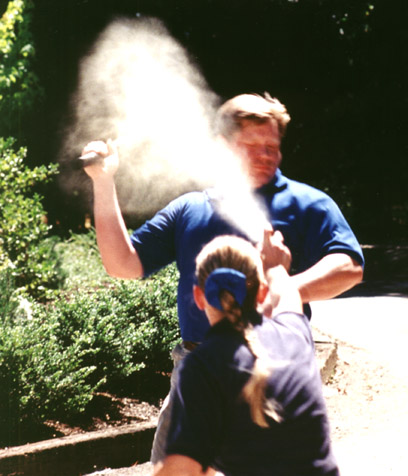
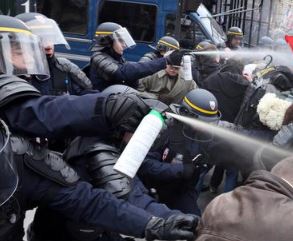
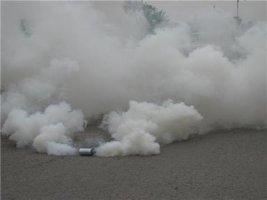
Attention si vous êtes l’utilisateur: apprenez à bien diriger le spray vers l’assaillant et pas contre vous, la cible ce sont les yeux de l’adversiare. Se placer ni triop près ni trop loin.A l’inverse pour éviter le flux il faut reculer et placer si possible un obstacle intermédiaire (masque…) Avec une grenade il faut s’éloigner car la diffusion gazeuse est impotrtante
Quand consulter ?
Rougeur oculaire, douleur, larmoiement et augmentation de la pression intra oculaire sont les signes classiques d’une exposition aux gaz lacrymogènes. Ils diminuent normalement au-delà d’une trentaine de minutes après l’exposition. Le mécanisme des lésions procède de l’irritation plus ou moins profonde et d’étendue variable de la couche superficielle de la cornée ainsi que de la conjonctive et des tissus proches. Le traitement est simple : collyre lubrifiant sans limite de dose et collyre antibiotique 3 à 6 gouttes par jour. Lorsque la douleur persiste ou qu’apparaît une baisse de la vision, il faut consulter un ophtalmologue en urgence si le tableau est plus important ou plus long. provoquant une (ulcération de la cornée ou une inflammation interne).
Des lunettes de protection, étanches, sont utiles en terme préventif. Mais elles restent imprégnées du toxique et il faut bien les laver après usage.
Diarrhées et troubles digestifs
En modèle animal, l’exposition au cyanure provoque des diarrhées pendant les jours qui suivent (Source : https://www.ncbi.nlm.nih.gov/pubmed/21791173 ).
Lors d’intoxications alimentaires impliquant du cyanure, notamment dans le cas de consommation de manioc contenant de forts taux de cyanure, il a été clairement montré que des symptômes de type nausées, vomissements, douleurs abdominales et diarrhées apparaissaient (Sources : https://www.ncbi.nlm.nih.gov/pubmed/30946738 , https://www.ncbi.nlm.nih.gov/pubmed/30766741 ). Cela se produit aussi aux Etats-Unis lorsque des enfants mangent accidentellement des fruits de plantes ornementales contenant du cyanure : nausées, vomissements, diarrhées suite à une légère intoxication au cyanure (Source : https://www.ncbi.nlm.nih.gov/pubmed/28421827 ).
Cependant, les mécanismes à l’origine de ces symptômes sont encore très méconnus. Il pourrait grossièrement s’agir d’une action inhibitrice sur les enzymes digestives (Sources : https://www.ncbi.nlm.nih.gov/pubmed/3245117, https://www.ncbi.nlm.nih.gov/pubmed/2788818 ).
SOUTH KOREA SUSPENDS TEAR GAS EXPORTS TO BAHRAIN
By Schams Elwazer, Mohammed Jamjoom and KJ Kwon, CNN
Updated 1124 GMT (1924 HKT) January 9, 2014
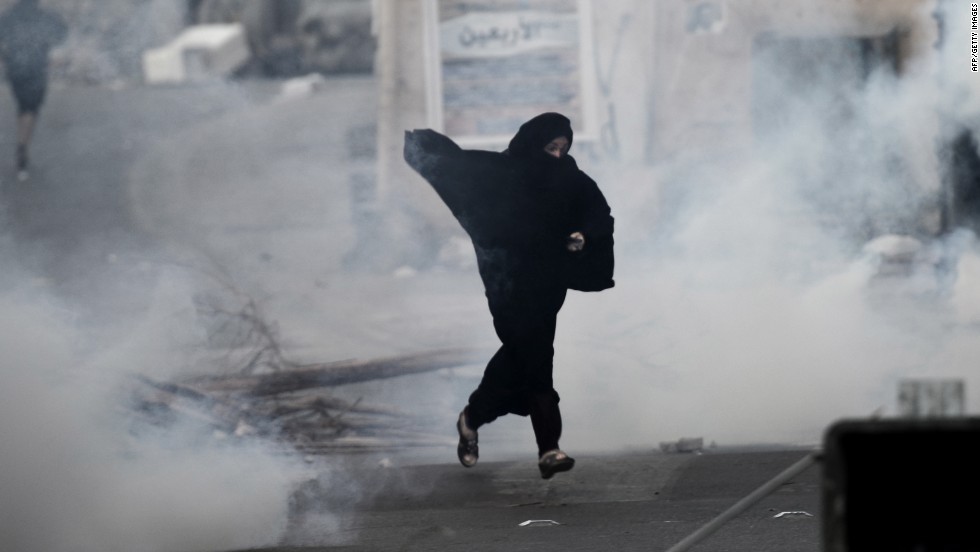
A protester runs from tear gas fired by Bahrain’s riot police during a protest west of Manama on December 17.
Story highlights
- Rights groups pressure the South Korean government to halt shipments to Bahrain
- The move comes after months of campaigning against the use of tear gas
- Bahraini authorities say tear gas is necessary to maintain order
- The Bahrain interior ministry says it was not told of the ban by Seoul
South Korea is suspending exports of tear gas canisters to the Gulf island nation of Bahrain amid pressure from human rights groups, an official said Thursday. »We’ve decided to suspend (the shipment of tear gas) because of the unstable political situation in Bahrain, requests from human rights groups and civilian deaths, » an official with South Korea’s state-run Defense Acquisition Program Administration (DAPA), which oversees the country’s military trade, said. »We got requests Dae Kwang Chemical Corporation and another company on whether they can get permission to export the tear gas to Bahrain, » the DAPA official said. »After discussions with the Defense and Foreign Ministries on the issue, we informed the companies to suspend the exports. »The move by Seoul comes after months of campaigning by rights groups who say the Bahraini authorities’ misuse of tear gas has led to dozens of deaths as the Shiite majority protests against the Sunni-led government. The authorities have argued that tear gas is necessary to maintain order.Human rights groups had launched a campaign called Stop The Shipment after leaked government documents appeared to show that Bahrain, a country of 1.3 million people, had ordered around 1.6 million tear gas canisters.In October, the U.S.-based group Physicians for Human Rights reported that Bahrain’s police « weaponized tear gas » had caused the deaths of at least 39 people since February 2011 in an ongoing crackdown on anti-government protests, a claim the government disputes.Bahrain’s Interior Ministry said it had not been informed of any such ban by Seoul. »Teargas is used by Bahrain’s police force only as a necessary and proportionate measure and in public order and riot control situations. It is used entirely in compliance with international law, » it said in a statement on Wednesday.Bahraini and international rights groups welcomed the move. »I think it’s great news and we commend South Korea on the decision they’ve taken, » Bahraini rights activist Maryam al-Khawaja said. »We’re starting with tear gas but we expect to see countries who say they are concerned about human rights stop the sale of all types of weapons to Bahrain. »
Documentaire Made in USA
Traduction par l’équipe du Lab Block avec la participation de nombreux volontaires voix !
Les aventures d’Alex – Répression
1) Filmer tue
J’ai décidé de revenir sur plusieurs faits qui se sont produits en cette année 2019 pour essayer de ne rien oublier, et de garder une mémoire précise et documentée des événements que j’ai vécus au niveau répressif et coercitif de la part des forces de l’ordre.
Tout d’abord, je n’étais pas un gilet jaune de la première heure, j’avais même évoqué des intérêts économiques étrangers à l’oeuvre pour accentuer cette mobilisation sur la base de cet article en m’exprimant même publiquement, en tant que spécialiste Fake News de l’académie de Nice, lors de la conférence Neuroplanète organisée par le magazine « Le Point ».
Pourtant, je me suis rendu à Nice le 23 Mars 2019 pour l’appel national des Gilets Jaunes, histoire de voir comment ça se passe, de discuter, puisqu’un gros événement avait lieu directement à côté de chez moi. Je ne savais pas trop à quoi m’attendre, mais lorsque je suis arrivé, j’ai surtout vu des forces de l’ordre qui avaient nassé des personnes âgées. J’ai été sommé de me disperser, et j’ai obtempéré, nous avons été repoussés en-dehors de la place Garibaldi, laissant à leur sort les pauvres manifestants restés sur la place et subissant alors des charges dans tous les sens.
Ce qui devait arriver arriva, Geneviève Legay fut gravement blessée. Mais je ne l’ai pas vu. J’étais déjà dispersé, sorti de la place Garibaldi, et en train d’attendre un ami, qui avait été expulsé de l’autre côté de la place et devait me rejoindre. Une rangée de policiers me barraient la vue et m’empêchaient de voir la place. J’ai alors entendu des gendarmes appeler au secours des médics, puis le commissaire Rabah Souchi, qui venait d’ordonner dispersion et charge, vêtu de son écharpe tricolore, ordonner l’interpellation de ces médics. J’ai décidé de filmer cette scène surréaliste, ce qui m’a valu également d’être pris. Je relate ces faits ici :
https://www.facebook.com/anne.francois.5473/videos/10157984780469179/
Fort heureusement, j’ai filmé comment je me suis fait interpeller :
Il est à noter qu’une autre personne a filmé une perspective très intéressante ici :
Et tout ceci est confirmé par le témoignage d’un des street médics :
https://www.facebook.com/thierry.paysant/videos/10216829638480628
https://www.facebook.com/thierry.paysant/videos/10216829638480628/
C’est alors que commence ma première expérience avec le système de répression français. Je n’avais pas imaginé que cela était possible. Dans un premier temps, un policier m’amène menotté à un fourgon. Ce fourgon nous transporte près de la caserne Auvare. C’est serré, inconfortable, dangereux même. On ne voit rien, on est menotté dans un espace extrêmement étroit et on se demande ce qui va se passer. Heureusement, d’autres voix montrent qu’on n’est pas seul, les médics sont là, ils plaisantent, pensent à sortir rapidement. Bonne ambiance, on essaie de faire contre mauvaise fortune bon coeur, et puis on se dit que c’est une erreur. Mais nous allons être parqués comme du bétail dans un enclos au soleil, attendant notre tour pour être présentés à un « OPJ », un officier de police judiciaire. Après de longues minutes – on n’a plus de notion du temps, car nos affaires nous ont été prises – à attendre, c’est une délivrance de pouvoir parler à cet « OPJ ». Mais il ne fait que nous informer de choses fausses et absurdes. Alors on conteste, mais il nous certifie que ce n’est qu’une information, qu’on aura tout le loisir de contester ensuite, qu’il faut signer comme quoi on nous a bien notifié ce motif. Mes souvenirs me disaient qu’il ne fallait rien signer, mais ça, c’est quand on a quelque chose à se reprocher non ? Je me dis que, n’ayant rien à me reprocher, je ferais mieux de collaborer pour sortir plus vite, comme tout le monde me l’affirmait. J’ai donc obéi. Pour sortir plus vite. Pas d’avocat, puisqu’on m’a dit que c’était certes gratuit mais que les « frais de déplacement seraient à ma charge » (mensonge). Pas de médecin, je vais bien. Juste, faites moi sortir rapidement s’il vous plaît parce que j’aimerais bien rentrer chez moi ce soir, c’est une grossière erreur là.
Eh bien non, me voilà placé dans une cellule pendant des heures et des heures. Une cellule consiste en un espace très réduit, quelques 6 m² tout au plus, avec trois banquettes en béton et des restes de fluides corporels divers (urines, sang, selles) sur les murs. Pas de matelas. Les habits en partie retirés au cas où le suicide nous aurait tentés. Et puis une attente. Aucune notion de temps. Rien à faire. Attendre. Un médic souhaitait aller aux toilettes, nous appelons timidement. Pas de réponse. Nous insistons, et recevons des insultes pour toute réponse. Mon estime pour les officiers de police commence à décliner. Après quelques heures d’attente – du moins je suppose – ce pauvre médic ne tient plus. Alors un gilet jaune un peu plus habitué décide de prendre les choses en main et tambourine à la porte. Son déferlement de violence contre cette pauvre vitre finit par payer, un officier vient pour lui proposer de se battre, provoque, essaie de le pousser à la faute pour pouvoir ajouter un outrage à son casier. Mais il n’y parvient pas. Et nous parvenons alors à exiger les toilettes – et ce gentil policier nous dira même l’heure : nous avions attendu 7 heures avant de pouvoir aller aux toilettes.
Mon audition a été très brève, et on changeait les pauvres bougres de cellule de temps à autre, on ne nous laissait pas trop dormir, certains étaient libérés le soir même, d’autres restaient…
Au petit matin, j’étais étonné d’être encore enfermé contrairement aux autres, et le geôlier a eu la gentillesse de me donner son idée : « c’est à cause du président Chinois en visite là… Ils ont décidé de libérer les gilets jaunes qu’ils connaissent et de garder les gens qu’ils connaissent pas au cas où…. ». Pour éviter qu’un dangereux black bloc ne s’en prenne au président Chinois, il fallait donc que je reste en cage 24 heures complètes. Et à la fin, on m’a remis ce papier :

J’étais outré. Révolté. Mais je n’ai pas basculé dans la violence, je ne souhaitais pas vengeance mais justice. J’ai donc contacté mes codétenus une fois sorti, essayé de motiver tout le monde, il fallait porter plainte collectivement.
C’est là que j’ai été confronté à tous ces étranges « aidants » qui nous disent quoi faire, qui démarcher, comment porter plainte et où. Entre les legal team, les associations officielles, toute une flopée de mythomanes a pris le parti de se faire passer pour telle ou telle association, d’assister à telle ou telle démarche, et me voilà passant d’un collectif à un autre, accompagné à saisir l’IGPN, le défenseur des droits, l’ONU… Un de ces collectifs m’a lancé sur les gaz lacrymogènes cependant. Et c’est donc pour cette raison que je m’y suis intéressé.
2) La trottinette volante
Un journaliste s’était intéressé aux gaz lacrymogènes et avait décidé de venir me suivre en manifestation à Paris. Nous nous sommes donc donnés rendez-vous au centre de Paris arrêt de métro Saint-Augustin, dès le matin de ce Samedi 21 Septembre 2019, pour aller à la rencontre des personnes ayant été exposées aux gaz lacrymogènes, afin que le journaliste se rende compte des effets sur la santé.Nous avons appris que des gaz lacrymogènes avaient été utilisés en intérieur et que des enfants avaient été exposés gare Saint-Lazare vers 9h30. Nous nous y sommes donc rendus et avons croisé des personnes nous confirmant ces faits. Cependant, les forces de l’ordre ayant fait barrage un peu plus loin, et tous les manifestants se rendant aux Champs-Elysées, nous avons décidé de faire demi-tour et de marcher en direction de l’avenue des Champs-Elysées. Nous avons été contrôlés et l’officier portant le RIO 1146648 a pris nos équipements de protection individuels sans dresser de procès-verbal de saisie, mettant en danger notre vie et notre santé face à l’arme chimique qu’est le gaz CS. Petite vidéo de l’ambiance le matin avant que je ne me fasse fouiller à mon tour :
Après plusieurs fouilles et barrages, nous avons été séparés : le journaliste a pu traverser les barrages sans fouille et est allé vers les Champs-Elysées, observant les gazages intensifs et discutant avec les personnes gazées pour connaître leurs symptômes, tandis que moi-même et le médecin qui m’accompagnait avons été fouillés assidument. Après plusieurs barrages, nous sommes arrivés sur l’avenue Friedland. J’ai vu au loin une personne au sol, qui venait d’être passée à tabac par des forces de l’ordre que j’ai vu partir en courant, monter dans leurs camions et démarrer à ce moment, abandonnant le jeune homme gravement blessé au sol.
J’ai appelé le médecin et nous nous sommes approchés de lui pour lui porter assistance, il était environ 11 heures. Après une longue attente, des habitants du quartier nous ont dit « ce n’est pas normal, les pompiers arrivent beaucoup plus vite d’habitude ». Je me suis donc décidé à aller au coin de la rue, cherchant des officiers de police, pour leur demander s’ils savaient où étaient positionnés les camions de pompier (j’en avais croisé certains sur le chemin mais ne me souvenais plus de leur position exacte). Ils m’ont indiqué une direction, et tout en m’y rendant, j’ai vu le camion de pompiers arrivés. Les officiers de police auxquels j’avais demandé le renseignement ont décidé de s’approcher pour sécuriser le lieu et l’évacuation du blessé, et je suis arrivé en leur compagnie. Pendant près d’une dizaine de minutes, nous sommes restés à proximité. Dès le départ du camion de pompiers, des officiers cagoulés et sans RIO, refusant de décliner leur identité, m’ont emmené pour « jet de trottinette » et « destruction de véhicule », m’ayant notifié ce motif à ma demande. Je leur ai signalé qu’ils faisaient erreur et que j’ai un physique suffisamment reconnaissable pour être disculpé. Mais ils ont persisté à indiquer qu’ils « me reconnaissent sur la vidéo » qu’il ne m’a pas été donné de visionner cependant. Très étonné je n’ai opposé aucune résistance mais n’ai cessé de leur répéter qu’ils faisaient erreur sur la personne.
https://www.facebook.com/alexsamtg/posts/10217880332533794
https://www.facebook.com/alexsamtg/posts/10217902856536880
Arrivé au commissariat du cinquième arrondissement, mes droits m’ont été notifiés et j’ai demandé à voir un avocat et un médecin. Un officier de police m’a dit « de toutes façons votre arrestation est politique ». On m’a donc placé en garde à vue pendant 24 heures. Durant ce temps j’ai demandé plusieurs fois à consulter les différents procès-verbaux y compris d’audition sans que ce droit ne m’aie été accordé. Les officiers de police se moquaient de moi et me traitaient comme si j’avais réellement jeté une trottinette : « on n’est pas ici par hasard ». Le médecin m’a signifié qu’il « n’aime pas les gilets jaunes » lorsqu’il m’a observé. Il n’y avait pas de couvertures car les officiers de police « nous faisaient une faveur en ne nous les proposant pas vu leur état ». Nous étions sept dans une petite cellule, dormant à même le sol.
Mes codétenus ont également eu leurs droits fondamentaux bafoués. Trois d’entre eux se trouvaient en garde à vue pour avoir eu des « armes » dans leur sac. Les armes étaient, en l’espèce, des masques à gaz et des lunettes de protection, soit des équipements de protection individuelle contre l’arme chimique équipant les forces de l’ordre et causant un problème de santé publique. Aucune autre arme ne se trouvait dans leur sac sauf pour l’un d’entre eux, qui avait pris des « objets incendiaires », ce qui lui a valu une prolongation de sa garde à vue. Ces objets n’étaient autres que cinq petits pétards festifs. Un détenu a été passé à tabac lors de son interpellation et est arrivé blessé. Il a été jugé n’étant pas apte à effectuer une garde à vue par le médecin, mais il est tout de même resté dans la cellule toute la nuit. Enfin un dernier codétenu devait prendre des médicaments, le médecin l’a confirmé, mais on lui a refusé les médicaments et la consultation du procès-verbal d’auscultation du médecin.
Lors de mon audition, il m’a été indiqué qu’un témoin ayant soi-disant une vidéo de moi en train de lancer la trottinette ne répondait pas au téléphone, et que je resterai en garde à vue avec prolongation possible tant que ce témoin n’a pas été retrouvé. J’ai pourtant fourni toutes les preuves indiquant que je ne pouvais être l’auteur de ces faits, et indiquant que j’avais des rendez-vous importants avec des scientifiques reconnus à honorer.
J’ai été relâché après 24 heures complètes de garde à vue, et des remarques désobligeantes des officiers de police m’indiquant que « j’avais de la chance qu’il n’y avait pas de caméras ». En sortant j’ai découvert le twitter du ministre de l’intérieur, indiquant publiquement (21 Septembre, 19h56) :
« Gratitude aux forces de l’ordre déployées sur tout le territoire pour préserver l’ordre et garantir la libre expression. Des individus violents ont été interpellés et les exactions stoppées. Le ministère de l’Intérieur reste vigilant et mobilisé : force doit rester à la loi. »
J’étais secoué par ces événements et j’ai eu besoin de communiquer à ce sujet sur le ton de la plaisanterie et de l’humour :
https://www.facebook.com/alexsamtg/posts/10217878821576021
https://www.facebook.com/alexsamtg/posts/10217880532938804
https://www.facebook.com/alexsamtg/posts/10217880549699223?__tn__=-R
3) La terreur du lave-vitre bio
Je pensais que ces aventures étaient enfin passées, que j’allais pouvoir envisager des choses plus sereines. J’avais un rendez-vous en centre-ville, et je m’étais accordé un samedi de pause, sans manif Gilets Jaunes, sans activités, juste voir une amie. Elle m’a donné rendez-vous place Masséna, le lieu le plus neutre de Nice. Je n’avais pas imaginé à ce moment que de dangereux terroristes avaient préparé un attentat. Et quel attentat. 9 d’entre eux ont comploté pour préparé une attaque de la banque Société Générale dans le cadre d’un mouvement global lancé par Attac. Je n’en avais pas connaissance, mais je connaissais de vue, car ils étaient présents en manifs, deux de ces odieux criminels. L’action était programmée pour 13h30, heure à laquelle j’ai péniblement trouvé une place pour garer ma voiture, assez loin de la place Masséna. Je me suis donc mis à marcher en direction de la place, passant à proximité de la banque vers 14h. Mon amie était en retard. C’est ainsi que j’ai vu ces militants se faire arrêter. Etonné du traitement qui leur était réservé, je suis allé saluer ceux que je connaissais et leur ai demandé ce qui se passait. Cela m’a valu un contrôle d’identité, auquel j’ai répondu en contrôlant l’identité des contrôleurs, leur demandant leur identifiant RIO obligatoire. Tous n’ont pas accepté de me le donner.
Un de ces officiers de police a alors décidé de mentir, et de m’accuser d’avoir participé à l’action, il m’a vu lancer de la peinture. Ce mensonge est sans doute dû au fait qu’il a refusé de me donner son RIO. J’ai été embarqué et j’ai immédiatement filmé ce qui se passait.
https://www.facebook.com/alexsamtg/videos/10218175996765215/
Il s’agissait alors d’un simple contrôle d’identité, mais une fois arrivé à Auvare, on m’a indiqué que ce serait garde à vue. J’avais l’habitude : médecin, avocat commis d’office, attente, OPJ… Je me suis ennuyé encore une fois pendant 24 heures. J’ai eu le temps d’apprendre que l’action de ces camarades de garde à vue était très bien préparée : du lave-vitre bio mélangé à du charbon, et non pas de la peinture, partant à l’eau et rendant une plainte ridicule. Mais ce que je ne pensais pas possible est arrivé : perquisition à mon domicile. Et quelle perquisition , on en a trouvé des choses !
https://www.facebook.com/alexsamtg/posts/10218202126858451
Après prolongation, ma garde à vue ayant duré 48 heures complètes, je suis allé soutenir ces militants dont j’ai découvert l’histoire. Et là encore, le respect des forces de l’ordre n’était pas trop au rendez-vous. Un peu de lecture, des échanges, et une tentative de sensibiliser ces officiers à la santé publique se sont malheureusement avérés être très infructueux. Je suis sorti dépité. Mais la presse s’en est un peu mêlée, qu’elle soit russe, française de gauche ou de droite.
Aucun des enquêteurs n’a jugé utile d’écouter mon répondeur cependant, alors que je leur avais proposé dès le départ. J’y ai donc trouvé ceci une fois que je suis sorti :
4) Joyeux anniversaire !
Pour l’anniversaire des 1 an des gilets jaunes, j’ai été place d’Italie. Nous avons été coincés, empêchés de sortir, et gazés toute la journée. j’ai voulu sortir, me disperser comme on me l’ordonnait, j’ai essayé de sortir par tous les côtés de la place : rien à faire.
https://www.facebook.com/alexsamtg/videos/10218363596575093/
https://www.facebook.com/alexsamtg/videos/10218364172669495/
https://www.facebook.com/alexsamtg/videos/10218364457636619/
https://www.facebook.com/alexsamtg/videos/10218364713363012/
https://www.facebook.com/alexsamtg/videos/10218365038651144/
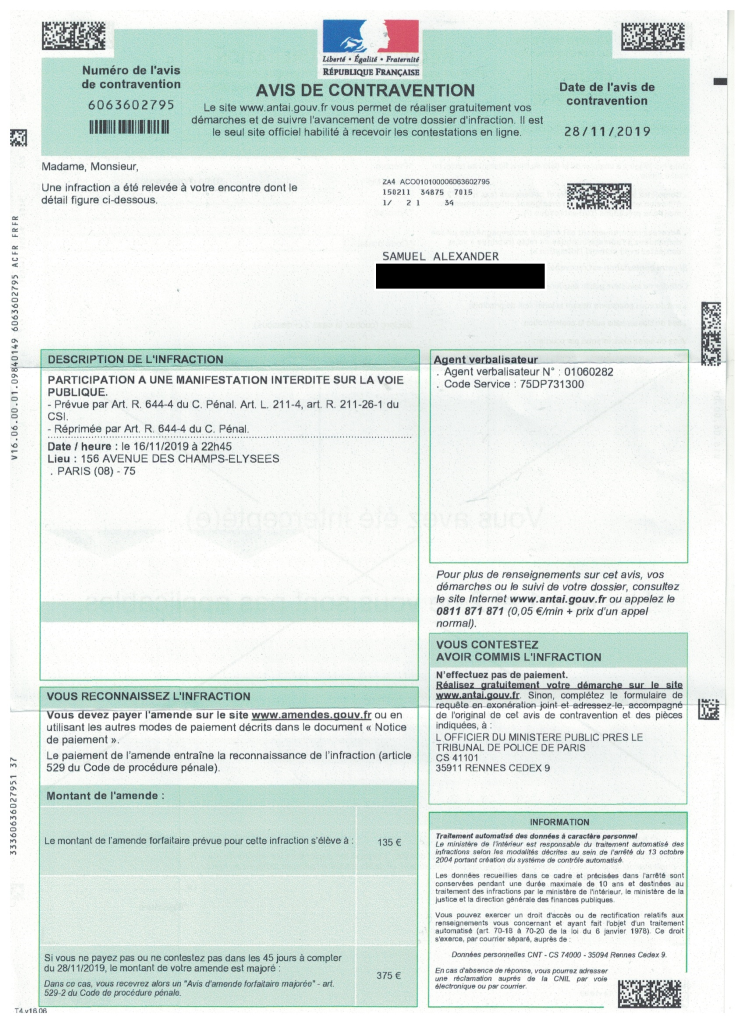
Le soir, dépités, nous sommes allés aux Champs Elysées, et nous avons vu tous les journalistes se faire fouiller, contrôler, tous le monde avoir peur, il régnait une ambiance de couvre-feu sans couvre-feu, comme si la police s’était transformée en milice pour empêcher toute expression publique. J’ai voulu casser cette ambiance de peur, j’ai été le seul à mettre son Gilet Jaune devant l’Arc de Triomphe.
Je ne manifestais pas vraiment, vu que j’étais seul. J’ai simplement donné une interview au seul journaliste qui a réussi à passer jusque-là (mais qui ne l’a semble-t-il jamais publiée) :
Ceci m’a valu une belle petite amende que voici :
5) Josiannnnne
Enfin, comme si ça n’avait pas suffi, le lendemain, en se préparant à rentrer, nous décidons de passer par Les Halles avec Josiane, médecin généraliste qui m’accompagne dans mes aventures. Nous avons été fouillés, un masque à gaz a été trouvé et voilà que Josiane se fait embarquer :
https://www.facebook.com/alexsamtg/videos/10218372922448234/
https://www.facebook.com/alexsamtg/videos/10218373121053199/
Gazage enfants
gazage Bébé
CONDUITES A TENIR MANIFESTATIONS
AVANT LA MANIFESTATION
Retirer: Bijoux, Lentilles de contacts, vernis à ongles, maquillage
Eviter: Rasage, épilation (au moins depuis 48h), tabac, alcool. L’application de crème hydratante (visage et corps).
INSCRIRE SUR VOTRE AVANT-BRAS GAUCHE (au marqueur !) : NOM, Prénom. Coordonnées avocat. Coordonnées de la personne à prévenir en cas d’accident. Groupe rhésus sanguin.
PENDANT LA MANIFESTATION
AVOIR SUR SOI : Pièce d’identité. Sucres /barres de céréales, eau Si possible : Copie carnet de vaccination ou juste date dernier rappel Tétanos ; noter sur un papier allergies médicamenteuses + traitement personnel
EQUIPEMENTS DE PROTECTIONS INDIVIDUELS :
ØCasques.
ØMasques à cartouche(s) FFP3B (à défaut 2B ou B ).
ØLunettes de protection bricolage étanches ( pas de lunettes de natation le verre n’est pas prévu pour les chocs, risque perforation des yeux).
ØChaussures type sécurité montantes (ou randonnée, etc..).
ØVêtements épais (si les températures le permettent),éviter les vêtements synthétiques très inflammables .
ØProtections auditives.
RISQUES POTENTIELS (principaux) :
ØMouvement de foules.
ØGazage.
ØFlash Ball.
ØGrenades désencerclement.
ØExplosion.
ØFeu.
ØCoups avec objets contendants.
CONDUITE A TENIR :
ØToujours rester avec votre groupe.
ØRepérer durant vos déplacements des « issues de secours ».
ØNe pas s’affoler, éviter de courir, être vigilant.
ØAider à établir un périmètre de sécurité en cas d’accident à la personne. Avertir les Soignants en cas d’accident = crier « MEDIC » en levant les 2 bras.